Author Archives: Will Hall

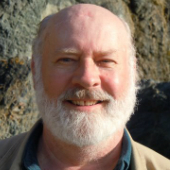
Madness and Renewal: Michael Cornwall

What if people struggling with madness could explore their emotions in a supportive sanctuary? Do frightening ‘psychotic’ experiences have the power to transform and heal? Is breakdown also breakthrough?

Michael Cornwall became a therapist after surviving his own crisis — without medication or psychiatric treatment. For more than 30 years he has worked in the tradition of Carl Jung and R.D. Laing to support people to go through psychotic states in medication-free community settings, including John Weir Perry’s Diabasis House in the 1970s.

http://www.madinamerica.com/author/mcornwall/
http://altmentalities.files.wordpress.com/2012/02/michael-cornwall-diss.pdf (PDF)

Laura Delano

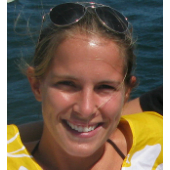
Coming Off Psych Meds: Laura Delano

What do you do when medications for your emotional problems become worse than the problems themselves? Laura Delano went to a psychiatrist at age 18, and for the next decade was prescribed nineteen different psychiatric drugs. After devastating physical and emotional effects, she began a journey to become medication free — and re-discover who she is. What lessons did she learn?

Laura blogs regularly about her experiences at Mad in America, works for a mental health agency in Massachusetts, and is an advocate for drug alternatives and safe withdrawal.

http://www.madinamerica.com/author/ldelano/
(Link to coming off meds guide: http://willhall.net/comingoffmeds/)

Coming Off Medications Guide Free Download – Now In Second Edition

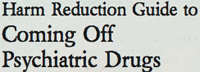
The Harm Reduction Guide to Coming Off Psychiatric Drugs, written by Will Hall and published by The Icarus Project and Freedom Center five years ago, is now available in a revised edition!

This Guide can be downloaded for free on this page: http://willhall.net/comingoffmeds

and the file can be accessed directly here: http://www.willhall.net/files/ComingOffPsychDrugsHarmReductGuide2Edonline.pdf

The new second edition has expanded Resources, scores of new collaborators and Advisors, new topics, more detail on the reducing and coming off process, and additional ideas for harm reduction and staying on medications. The Guide is Creative Commons copyright BY-NC-ND, meaning you have advance permission to copy, print, link, publish and share as much as you want (a special printer ready version is here: http://www.willhall.net/files/ComingOffPsychDrugsHarmReductGuide2EdZinePrint.pdf with instructions here: http://www.willhall.net/files/ComingOffHarmReducGuideAssemblyInstructions.pdf

Thousands of people worldwide have used this Guide to help themselves and people they know become more empowered around medications, including coming off. Hundreds of professionals and mental health agency staff have been downloading the free guide, to fill gaps in their own knowledge and give to their clients. Now the Guide in its second edition is even better, incorporating reader feedback and new ideas.

Since being published, the Guide has been translated into Spanish, Greek, and German, was featured in the Journal of Psychiatric and Mental Health Nursing, and has been used as workshop and training curriculum. 5 years ago what seemed to many as an unspeakable topic too radical for print has proven to be wildly successful. It’s helping people around the world, in the words of the introduction, to “trust themselves more and take better care of one another.” (Read about the making of the Guide here.)

What are some of the differences with the new Second Edition: Continue reading

Author Staci Haines

Healing Sex: Staci Haines

Childhood sexual abuse is pervasive in our society, leaving lifelong wounds that affect men as well as women. Is it enough to hold perpetrators accountable, or are there deeper causes of abuse? Do police, courts, and child protection services help heal — or lead to more trauma? And how can body-oriented approaches move beyond the limits of talk therapy?

Child sexual abuse survivor Staci Haines, author of Healing Sex: A Mind-Body Approach to Healing Sexual Trauma and co-founder of Generation Five, discusses transformative justice and liberating society from child abuse.

http://www.generationfive.org
http://www.generativesomatics.org
http://bit.ly/MrJeRp

Continue reading

Transcriptions of Madness Radio Shows Available – John McCarthy, Robert Whitaker, Jacqui Dillon, and Terry Kupers

Tsuyoshi and Makoto MatsuoTranscriptions of some past Madness Radio shows are now available, thanks to the efforts of volunteer Madness Radio listeners Tsuyoshi Matsuo and Makoto Matsuo from Japan and editor Alex Maymi!

John McCarthy (.pdf)

Prison Mental Health Terry Kupers (.doc)

Robert Whitaker at Powells Books (.docx)

Jacqui Dillon Hearing Voices (.docx)

Your Input Welcome For 2012 Alternatives Keynote Speech – SURVEY

I was invited to give a Keynote Address at the 2012 Alternatives Conference in Portland Oregon, and I’m collecting your input on what I should say — I’m crowd sourcing my Keynote!

Please go to this Survey and take a couple of moments to share YOUR input on what my Alternatives Keynote address should cover: http://www.surveymonkey.com/s/YMH9B28

Continue reading

Meaning From Voices: Eleanor Longden

Hearing voices is strongly connected with traumatic experiences, but are voices a brain malfunction or a creative strategy for protection?

UK psychologist Eleanor Longden survived a diagnosis of paranoid schizophrenia and went on to be a leading researcher around voice hearing, trauma, and dissociation. She is a pioneer in the movement to understand voices as a normal human experience — and truly help people by healing trauma.

http://ind.pn/3ltxoe
http://bit.ly/NjDA77
http://bit.ly/z01Fhn

Continue reading

Dr Toby Watson

Ethical Therapy: Toby Watson

Can psychotherapy be a replacement for medication for psychosis and extreme states? Should therapists hospitalize suicidal clients against their will — even when they could be traumatized by the very care intended to protect them?

Dr. Toby Watson, clinical psychologist, discusses how to be an ethical therapist in an era of medications, diagnostic labels, and forced treatment.

http://www.abcmedsfree.com/

Bipolar Children by Sharna Olfman

Bipolar Children: Sharna Olfman

Why are so many children being diagnosed bipolar? Do medications treat disease – or just keep children under control? What else can parents do when faced with difficult behavioral problems?

Sharna Olfman, Psychology Professor at Point Park University and editor of the book Bipolar Children, discusses the growing social and economic pressures to label children bipolar.

http://dai.ly/epbcoO
http://scr.bi/yFfoRN

Metsa Niwue

Amazonian Healing: Metsa Niwue

Shamans of the Amazon jungle heal the spirit by communicating with plants and singing people back to health. Can indigenous medicine, including the psychedelic ayahuasca, help anxiety, depression, and addiction? What do healers of Peru have to teach us about mental health?

Metsa Niwue, a curandero who has studied for more than sixteen years with the Shipibo and Quechua Lamista peoples, discusses the promise and potential dangers of traditional Amazonian plant medicine for the west. (transcript)

http://vegetalismo.org
http://www.neip.info/upd_blob/0000/982.pdf

Leah Harris Joins Madness Radio Team as Technical Director

I’m very excited to announce that Leah Harris has joined Madness Radio as our new Technical DIrector!
Leah is a longtime psychiatric survivor activist, a filmmaker, a mom, and a performance poet. I interviewed Leah on the show and you can listen to it here —

https://www.madnessradio.net/madness-radio-survivor-spoken-word-leah-harris

I invited Leah to work with Madness Radio after a donor provided funds to cover costs — thanks to that anonymous donor! Leah will be editing shows, managing our online archives, and providing technical assistance to keep things running smoothly.

Welcome Leah!

Watch Leah’s video Beyond the Dirty Window on YouTube, or below.

Order Leah’s spoken word CD “Take Refuge”

Download Leah’s songs as MP3s.

Her book of poetry, entitled “Poems of Mass Construction” is available here.

Excellent UK Article on Anti-Psychotic Drug Harm Reduction in Journal of Psychiatric and Mental Health Nursing

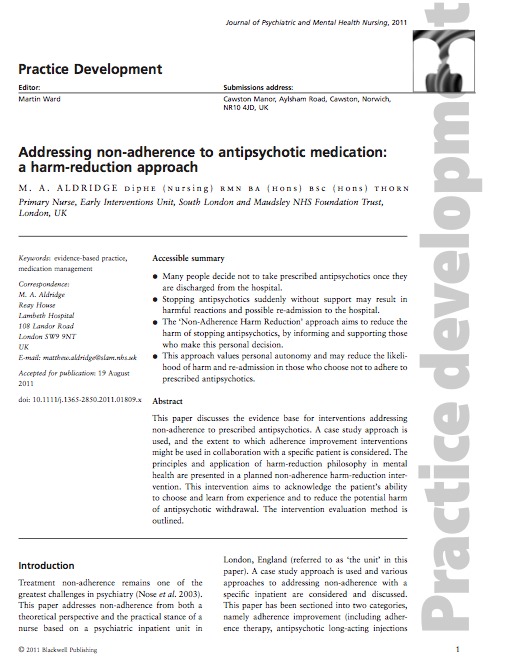
Matthew Aldridge, a psychiatric nurse at London’s Lambeth Hospital, just published a new article in the 2011 Journal of Psychiatric and Mental Health Nursing, “Addressing Non-adherence to Antipsychotic Medication: a Harm-Reduction Approach”.

This is an extraordinarily well researched clinical discussion of professional medication practice that draws a lot from the Harm Reduction Guide To Coming Off Psychiatric Drugs that I wrote with The Icarus Project and Freedom Center. A very useful resource for giving to professionals and clinicians facing these issues.

You can download the article here:

http://bit.ly/wbUA6A

And here are the summary and abstract:

Summary
Many people decide not to take prescribed antipsychotics once they are discharged from the hospital. Continue reading

New Video: Coming Off Psychiatric Drugs: A Harm Reduction Approach | Will Hall

With the help of Portland visionary colleagues Kent Bye, Jen Gouvea, and Jonathan Marrs I produced a short introductory video of me describing coming off psychiatric drugs. The approach is drawn from my Harm Reduction Guide to Coming Off Psychiatric Drugs, which can be downloaded for free here: http://willhall.net/comingoffmeds

This video provides some basic guidance for anyone considering reducing or coming off psychiatric medications and their supporters, which is discussed in greater detail in the Harm Reduction Guide. This video and Guide are in the spirit of peer support and mutual aid for educational purposes, and not medical advice. (While everyone is different, coming off medications, especially abruptly, can sometimes be dangerous. Seek support when possible and use caution.)

You can contact me at http://www.willhall.net

Please share this video; it’s Creative Commons copyright 2011 BY-NC-ND and the url is here: http://youtu.be/O4bdG601k4k

Grainne Humphrys

Chemical Crucifixion: Grainne Humphrys

Could a young man’s overwhelming visions of Christ and apocalypse be a creative response to life trauma, rather than signs of paranoid schizophrenia? Does madness unfold differently depending on whether it is supported – or feared?

Irish activist and punk musician Grainne Humphrys, herself a survivor of an extreme state, discusses the campaign for the release of former partner John Hunt. John has been incarcerated and drugged against his will since 2005, sparking international outcry.

http://freejohn-loverevolutionary.blogspot.com
http://www.mindfreedomireland.com

Continue reading