Author Archives: Will Hall

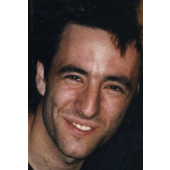
Daniel Mackler

Therapy for Psychosis: Daniel Mackler

Can therapy reach people in extreme states of “psychosis” — without using medications? Do we need to give a diagnosis to help someone? Why are counselors afraid to listen to their “mad” clients?

New York psychotherapist and filmmaker Daniel Mackler discusses how be defied social work training in his work with people labeled with schizophrenia and bipolar, and what he learned from recent visits to successful treatment alternatives in Northern Europe. Daniel is the filmmaker of Take These Broken Wings and co-author with Matthew Morrissey of A Way Out of Madness.

http://www.iraresoul.com

Human Rights Report on Mexico Mental Health Abuse

Abandoned & Disappeared: Mexico’s Segregation and Abuse of Children and Adults with Disabilities is a report by Disability Rights International and the Comisión Méxicana de Defensa y Promoción de los Derechos Humano. Freedom Center co-founder and Madness Radio producer Will Hall is one of an international group of co-authors, and was part of the investigative team for the report, traveling to Mexico on an investigative mission in 2009.

Here’s an excerpt of what the recent coverage in the New York Times said:

Ten years ago, a human rights group released a scathing, groundbreaking report on abusive, decrepit conditions in Mexican institutions for the mentally and physically disabled, moving the country to promise change and to take the lead in writing international agreements to protect the disabled.

But in a new report released Tuesday, the group, Disability Rights International, working with a Mexican human rights organization, said a yearlong investigation revealed “atrocious and abusive conditions” that included lobotomies performed without consent, children missing from orphanages, widespread filth and squalor, and a lack of medical care.

You can read the report online here: http://www.disabilityrightsintl.org/wordpress/wp-content/uploads/Mex-Report-English-Nov30-finalpdf.pdf

Paid Pharmaceutical Company Consultants are Fans of Madness Radio…

Janssen_Pharmaceutica-logoI just received an interesting email about National Family Caregiver’s month. Apparently Madness Radio has fans at Janssen Pharmaceuticals…

Follow the asterisks…

Thu, Nov 4, 2010 at 12:09 PM
Subject: Interview opportunity regarding schizophrenia

Hi Will,

We have an interview opportunity which I think would be a great fit for Madness Radio. The interview is with a schizophrenia patient and her mother. They are trying to raise awareness about caring for people with schizophrenia. Please see below for a press release. Please let me know if you have any questions or would like any additional information. We could tape the interview on our end and send an mp3 file if that would help? The patient and her mother both requested that we reach out to you, they are fans of your program.

Best Regards,
Rob Gottlieb

RADIO INTERVIEW OPPORTUNITY
Tuesday, November 23, 2010
7:00 a.m. – 11:30 a.m. ET
THE CHALLENGES OF CARING FOR SOMEONE WITH SCHIZOPHRENIA

Mom discusses stigmas, how to stay positive and ways to provide encouragement

November is National Family Caregiver’s Month

Decades ago, psychiatric institutions were largely in charge of caring for patients with schizophrenia. Now, families play a much larger role. Research shows a profound psychosocial, physical and financial impact on the families of people with mental illness. The burden of caring for people with schizophrenia is comparable to that of caring for people with Alzheimer’s Disease or cancer. Yet, these caregivers tend to be overlooked.

There are many concerns in caring for someone with schizophrenia, including housing, financial and social difficulties. Another concern is helping a loved one with schizophrenia keep up with his or her full treatment plan, which usually includes medication, psychotherapy and other activities. While there is no cure for schizophrenia, treatments have been found to manage symptoms and reduce the risk of relapse. Claire advises, “Think in terms of the recovery process. There are many avenues of help along this path. Be glad you are able to take advantage of the abundance of supportive resources we have today—better than at any time in the past.”

Given that November is National Family Caregiver’s Month, we hope you’ll consider exploring this topic and are offering interviews with:

Claire and Rebecca Phillips,* a mother-daughter pair who have been working together to deal with the challenges of schizophrenia since Rebecca’s diagnosis in college. They can share insights and advice from both perspectives. “Realize that the symptoms are not the person! The diagnosis is not the person! The family member needs your positive attitude and encouragement,” says Claire.

Psychiatrist Rebecca Roma, MD,* is Medical Director of the Community Treatment Team at Mercy Behavioral Health in Pittsburgh, Pennsylvania. “Unlike other disabilities, the lack of insight that can occur with people with schizophrenia makes offering support a challenge,” she says. Dr. Roma is only available between 7-9 a.m. ET.

SUGGESTED QUESTIONS:
Is there a stigma associated with having schizophrenia? What are some of those stigmas?

What is schizophrenia? How can you recognize that someone may have schizophrenia?

When did you find out that you/your daughter had schizophrenia? Did you know anything about the disease at that time?

How did the diagnosis affect you/your family?

What are some of the challenges of being caregiver for someone with schizophrenia?

What advice do you have for people who have a family member that has been recently diagnosed with schizophrenia?

What are some the supportive resources you rely on to help you provide care for your daughter?

TO SCHEDULE AN INTERVIEW, PLEASE CONTACT: Robert Gottlieb @ (908) 301 0819

This interview is courtesy of Janssen®, Division of Ortho-McNeil-Janssen Pharmaceuticals, Inc.

*These individuals serve as paid consultants by Janssen®, Division of Ortho-McNeil-Janssen Pharmaceuticals, Inc. for their involvement with this awareness initiative.

Agnes's Jacket by Gail Hornstein

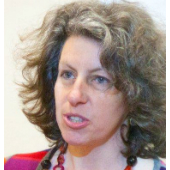
Meanings of Madness: Gail Hornstein

Seamstress Agnes Richter was locked away in a mental asylum in the 1890s, and was so determined to have a voice that she embroidered her personal story onto the jacket she wore on the ward. What is the hidden history of people writing their own narratives of going insane? How important is it to listen to the experiences of “mentally ill” people? Is there meaning in madness?

Gail Hornstein, Mt. Holyoke College professor and author of Agnes’s Jacket: A Psychologist’s Search for the Meanings of Madness, discusses the work of the Hearing Voices Movement in the UK, peer run support communities including Freedom Center in the US, and why professionals should let patients speak for themselves.

http://www.gailhornstein.com
http://bit.ly/aG9bnS

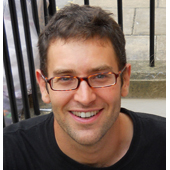
Sascha Dubrul

Icarus Project: Sascha DuBrul

How did the New York underground of punk rock music, squatting, and homeless protest give rise to a thriving and innovative peer-run mental health community? Are there creative gifts to be found in the depths of madness? Does the future of Mad Pride lie in the joining of activism with spirituality?

Icarus Project co-founder Sascha Altman DuBrul discusses his escape into apocalyptic visions and psychiatric hospitals, and how he was inspired to challenge the identity of bipolar disorder.

scatter(at)theicarusproject(dot)net
http://www.theicarusproject.net

Update: Alternatives Mental Health Conference Restores Coming Off Medication Workshop

Alternatives 2010 Logo

In a sudden reversal, the National Empowerment Center has announced it is restoring my workshop on coming off psychiatric medication at the Alternatives 2010 mental health conference in Anaheim California. (You can read about their original decision here: https://www.madnessradio.net/coming-off-medications-workshop-censored)

The National Empowerment Center, organizer of the annual event, had censored “coming off medications” from the workshop description and title, which led me to decide to not attend the conference. News spread quickly on the internet, and the resulting outcry from mental health consumers and the public led to the workshop’s reinstatement and an apology from Daniel Fisher, Director of the National Empowerment Center.

I want to thank everyone who spoke up about this. I hope the change is a sign that mental health policy can become more honest about medication risks and more open to the need many people have for alternative choices. I also want to thank Dan Fisher and the National Empowerment Center staff personally for the thoughtful discussions we’ve had on this matter. By including coming off medications as part of the conference agenda, they are helping promote the wellness and self-determination that are at the heart of what our movement stands for.

Here is the announcement that Dan sent out today:

1:01PM 09-27-2010
Good news re: workshop by Will Hall at Alternatives 2010

Please forward widely. Thanks, Dan

On behalf of the National Empowerment Center, Inc., I wish to apologize to Will Hall and to the consumer/survivor community for the last-minute decision to alter the title of his workshop to remove the reference to coming off medication.

The original workshop title, “Coming Off Medications: A Harm Reduction Approach,” will be restored, and we are delighted Will has agreed to come to Alternatives and present on this subject as originally planned.

I appreciate that this issue has created an opportunity for significant dialogue. It is my expectation that this dialogue about the importance of shared decision-making on starting, reducing, or coming off medications will continue, at Alternatives and beyond.

Daniel B. Fisher
Director
National Empowerment Center, Inc.

Coming Off Medications Workshop Censored at ‘Alternatives 2010’ Mental Health Conference

Alternatives 2010 Logo

UPDATE: The National Empowerment Center has reversed its controversial decision amid public outcry, and the workshop will be restored. Read about the reversal here: https://www.madnessradio.net/update-coming-off-medication-workshop-restored

Hi everyone, I’m writing to let you know that Alternatives 2010< has withdrawn its previous approval for my workshop on coming off psychiatric medications. Two days ago I received word that the National Empowerment Center decided to rewrite the workshop description to exclude any reference to "coming off medications," which is a central part of the workshop content. Because I cannot go along with this decision I will not be attending the conference. Below is a press release explaining the situation; please share this with others if you are interested."

PRESS RELEASE:

MENTAL HEALTH CONFERENCE CENSORSHIP

Coming Off Medications Workshop Censored at ‘Alternatives 2010’ Mental Health Conference

Alternatives, the mental health consumer/survivor conference with more than 1,000 participants annually, has withdrawn its previous approval for a workshop on coming off psychiatric medications.

The workshop, based in a pro-treatment choice, harm-reduction philosophy, was to share information about continuing, reducing, or coming off medications. After approving the workshop in June, the National Empowerment Center, which organizes the conference to be held in Anaheim California, made a last-minute decision to change the title and description to remove any reference to coming off medications.

Will Hall, an internationally-recognized schizophrenia survivor and radio host who was set to lead the workshop, decided that he could not go along with the decision and will not be attending the conference. “Coming off medications is a topic vital to wellness and recovery, and should not be censored,” he said.

The controversial move by the National Empowerment Center comes in the wake of a recent similar decision to bar Robert Whitaker, a Pulitzer finalist investigative journalist whose work spotlights medication dangers and growing evidence that non-drug alternatives work better for some patients. Whitaker was restored as a conference keynote speaker only after mental health advocates mobilized quickly on the internet to challenge the decision.

The annual Alternatives conference is organized by consumer/survivor groups and federally funded. With workshops ranging from wellness, youth, housing, employment, advocacy and diversity issues, Alternatives is the country’s most prominent gathering for mental health consumers, who attend from all US states and as far away as Guam. Medication issues, however, have consistently been excluded from the program.

Hall, who works as a therapist, says he educates individuals, families, and health care providers to make more informed choices,and is not anti-medication and does not give medical advice. “People are caught between pro-drug marketing by pharmaceutical companies and the anti-drug message of some activists. We need honest and unbiased information about psychiatric medications, including assessing drug risks and discussing how to come off drugs safely when they aren’t right for you. Many people find medications helpful, but there are huge dangers involved, and sometimes it’s better to reduce medication or slowly go off.

After several hospitalizations and a diagnosis of schizoaffective disorder schizophrenia, Hall has been medication-free for more than 17 years. He says a combination of holistic health, support groups, and spiritual practice nurtured his recovery from mental illness, but believes that “each person’s path to recovery is different. My work fills a great need for information, and it’s a shame this topic is censored at a national conference that claims to be dedicated to wellness and calls itself ‘Alternatives.'”

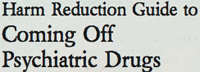
Hall is the author of the Harm Reduction Guide to Coming Off Psychiatric Medications, published by mental health peer groups The Icarus Project and Freedom Center. The guide, available freely on the internet, has been distributed to more than 15,000 people and is available in Spanish and German translations.

http://theicarusproject.net/HarmReductionGuideComingOffPsychDrugs

Robert Whitaker “Anatomy Of An Epidemic” At Powells Aug 2010 – Video + Audio

Robert WhitakerRobert Whitaker, author of Anatomy of an Epidemic: Magic Bullets, Psychiatric Drugs, and the Astonishing Rise of Mental Illness in America, spoke in Portland Oregon August 19 2010, at events sponsored by Portland Hearing Voices and co-sponsored by the Mental Health Association of Portland, Empowerment Initiatives, and the National Association of Social Workers – Oregon Mental Health Network.
More than 250 people attended the standing-room only talk at Powell’s Books; some 65 people were at the afternoon seminar “Ethical Medication Policy In Clinical Settings,” and more than 30 at the morning forum for people with mental health diagnosis, “Medications and the Recovery Movement.” Will Hall introduced Whitaker at Powells and spoke at the other events,and Myriam Rahman, therapist and Portland Hearing Voices trainer, as well as recovery movement leaders Laura Van Tosh and Mike Hlebechuk, were also speakers.

Listen to the audio recording of Whitaker and Will Hall at Powell’s here:
https://www.madnessradio.net/audio-extra/RobertWhitakerWillHallPowellsBooks08-19-2010-.mp3

Listen to the audio of Whitaker, Will Hall, and Myriam Rahman at the MedicationEthics seminar here:
https://www.madnessradio.net/audio-extra/RobertWhitakerWillHallMyriamRahmanEthicalMedication08-19-2010.mp3

You can watch the video of Whitaker’s talk at Powell’s Books here:

Dr Joanna Moncrieff

Bipolar Medication Myths: Dr Joanna Moncrieff

Is bipolar disorder a disease? Can medications like lithium correct chemical imbalances and stabilize mood? Do psychiatric drugs act completely differently on the brain than recreational drugs?

UK psychiatrist Dr. Joanna Moncrieff, author of The Myth Of The Chemical Cure: A Critique of Psychiatric Drug Treatment, discusses how seeing psychiatric medications as treatments for disease misleads the public about how they actually work, and obscures their potential for abuse as tools of social control.

http://www.critpsynet.freeuk.com
http://www.academyanalyticarts.org/moncrieff.htm
http://www.mentalhealth.freeuk.com/howwork.pdf

Will Hall Talk On Hearing Voices at Toronto Voices Conference – Audio

I just gave a talk in Toronto Canada as part of the “Do You Hear What I Hear? Alternative Perspectives on the Voice-Hearing Experience” conference.

The gathering brought together 150 participants, a mix of people with psychiatric diagnoses, family members, professional service providers, and the general public to hear about a non-pathologizing and empowering way of approaching voice-hearing. Also on the panel were Rufus May and Jacqui Dillon of the UK Hearing Voices Network. The conference was organized by the Leadership Project in Toronto and was part of the city’s Mad Pride celebration, and was the kickoff event for the new Canadian Hearing Voices Network.

You can listen to audio of my talk here:

Portland Hearing Voices Poetry Event Draws a Crowd – Audio

Madness Poetry Someday Lounge July 13Portland Hearing Voices, the support and education project I direct in Portland Oregon, recently had a Poetry and Madness Benefit show at the Someday Lounge. Prominent poets Emily Kendal Frey, Zachary Schomburg, and James Gendron read their beautiful and powerful writing, and myself, Myriam Rahman, Anusuya Starbear and Jenny Westberg talked about Portland Hearing Voices and our work for mental diversity.

Read about it at the Mental Health Association of Portland website, and you can listen to the complete audio recording of the event here:

https://www.madnessradio.net/audio-extra/PoetryAndMadnessSomedayLoungeJuly13-2010PDXVoices.mp3

Author Jonathan Metzl

Schizophrenia and Black Politics: Jonathan Metzl

How did the definition of schizophrenia change during the civil rights and Black Power era of the 1960s? Why did a disease primarily affecting withdrawn white housewives suddenly become focused on angry and “paranoid” African American men instead?

Psychiatrist and historian Jonathan Metzl, author of The Protest Psychosis: How Schizophrenia Became a Black Disease, discusses racism and social control in psychiatric diagnosis, and how Black protest was turned into a mental disorder and psychosis was a political tool.

jmetzl(at)umich(dot)edu
http://bit.ly/byOeIw