
Art and Schizophrenia: Louis Sass
First Aired: 06-30-2009 -- 6 comments | Add comment
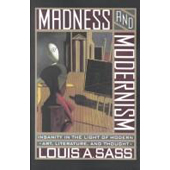
Does modern art, such as Artaud, Beckett, and Duchamp, parallel the mad frames of mind that get labeled “schizophrenia?” Is extreme sensitivity and inner self-consciousness behind artistic innovation and breaks with reality?
Rutgers University psychologist Louis Sass, author of Madness And Modernism: Insanity in the Light of Modern Art, Literature, and Thought, discusses art as an insight into the subjective inner world of madness.
Podcast: Play in new window | Download (Duration: 53:50 — 49.3MB)
Subscribe: RSS
- Show topics:
- Art
- Books
- Hearing Voices
- Mad Science
- Philosophy















 Creative Commons 2.5 copyright
Very interesting interview, thanks Will.
Sociologist Liah Greenfeld is finishing work on a book about mental illness and modern culture, which I recently wrote about in a multi-part exposition on my blog (http://www.mindofmodernity.com)
Greenfeld defines culture as the symbolic transmission of human ways of life and identifies it as an emergent phenomenon – a new reality with its own rules, that nonetheless operates within the boundary conditions of life. This symbolic reality is only alive, (the process can only occur), in individual brains, hence the understanding of the mind as “culture in the brain,” or “individualized culture.” Three important “structures” of the mind – (patterned and systematic symbolic processes which must be supported by corresponding patterned and systematic processes in the brain) – are identity, will, and the thinking self.
Identity – the relationally constituted self – is always a reflection of a particular cultural environment. Greenfeld hypothesizes that the lack of direction given by modern culture makes the once relatively simple process of identity formation much more complicated. A well formed identity functions as a map of the relevant sociocultural terrain and the individuals place in it, making possible the subjective ranking of the choices present at any moment, giving the will, (or acting self), a basis for decision-making. It follows then that problems with identity formation lead to problems with the will. Malformation of identity and impairment of the will necessarily affect the functioning of the thinking self (the “I of self-consciousness”) – the part of the mind which is explicitly symbolic in the sense that it operates with formal symbols – above all, language. The thinking self may become fixed on questions of identity; it may have to stand in for the will, when a person has to talk him/herself into acting in situations which normally wouldn’t require self-conscious reflection (e.g going to the bathroom, eating, getting out of bed); or in the most severe cases, the thinking self may become completely disconnected from individualized culture, in which case all the cultural resources of the mind range free, without direction from identity and will.
Sass’s work and attention to the experiences of people diagnosed as schizophrenic made his book an important source for Greenfeld’s own book. Some of the experiences he describes (and hopefully some of the experiences of visitors to this site) become more intelligible within her new framework.
One of Greenfeld’s most important observations about the language and thought of those diagnosed with schizophrenia is that it is not simply devoid of content or “disorganized.” Rather, it is unconstrained by logic proper, (aristotelian logic based on the principle of no contradiction), and the various contextual logics at work in a particular culture and time. She points out that the importance of logic in modern society obscures the fact that its development was an historical (and thus cultural) phenomenon, that it is not an inherent, universal ability. We falsely assume the absolute need for logical thinking in formal thought, (which probably plays right in to the biological framework). In fact, even in modern society, “normal” people switch between contextual logics all the time – the example in the interview of the intense focus on something like a handshake is interesting because this is a perfect example of an instance when a particular cultural logic (that is not aristotelian logic) is at work. Most members of the society recognize this as the “logical” action given the context – there is no self-conscious thought required to deduce this – though in a different cultural context the same action might be completely absurd. If the individualized part of the mind – the part that internalizes the multitude of cultural conventions – is not functioning normally, a disturbing consciousness of both the external world and the self may result. The process of piecing the world together, (for the most part usually not a self-conscious process), becomes an explicit effort.
While the sufferer may lack the individualized part of the mind, the general resources of culture, above all language, are often incredibly active, and without direction from the will on the basis of a clearly experienced identity, the symbolic resources of the mind seem to run free. The example given by Sass of the patient who, given a Rorschach test, ends up discussing the concept of contrast, and Will’s story of being unable to answer the questions posed in the MMPI because of being drawn in to musings on the nature of multiple choice show this phenomenon at work. Surely there were intelligible and perhaps valuable insights into these issues, but the will was unable to direct the attention where it was required – to saying what one sees in an ink blot, or simply choosing the most appropriate answer out of several choices.
The connection with poetry and art seems very important as well. While certainly there are modern writers and artists who have suffered from mental illness, Greenfeld identifies the primary difference between some forms of art and schizophrenic language by relating back to the mental structure/process of will. While the author wills him/herself to “let go” as it were and be carried away by the various sonic and semantic connections in language which are usually not central to everyday speech, in schizophrenia this “undirected rush of speech” (Greenfeld’s term) cannot be switched on and off – it seems to speak itself and is often experienced as “an oppressive external force.” The connections between thoughts and statements are led by the associations inherent in language (which are of course almost infinite and can go in any number of directions) rather than by intention.
These are just a few briefly summarized aspects of Greenfeld’s work that seemed particularly relevant to this interview – I’m happy to say more if people are interested.
David
I agree it is a phenomenon but that it is a societal phenomenon of ‘splitting’ and not one neatly contained within the individual. Society creates a neat dividing line between the sane and the insane, the ‘normal’ and the ‘abnormal.’ That is a comforting illusion for the group considering itself to be the sane ones but it is not reality. It is far too neat for that. If seen differently; let’s say as an effect on the individual who gets labelled ‘abnormal’ rather than as a self contained cause rising up from within a defective human being, then what is seen, heard and understood will take on a whole new meaning which may well shock a lot of people. Spend a little time thinking about that.
It is also not hard to accept the labelling system when it is applied to others and not to oneself. The labels are not just descriptions of something; they are definitions of ‘defective’ people; people who get treated very differently by a society that defines them that way.
I suggest the problem really lies in the ‘them and us’ illusion which these defining labels tend to promote and support.
“Normal’ people have a problem understanding the “abnormal” because a line is drawn, separating others from the possibility of understanding. What is normal is to self define. What is abnormal is to be defined by others and told we must accept that. Would a psychiatrist accept that? The ‘difference’ then becomes expressed like this:
Do ‘we’ isolate because we are ‘different’?
Or
Does society isolate ‘us’ because it has been taught and has accepted to see us as ‘different.’
Do ‘we withdraw’ from society?
or
Does society push out those it perceives as ‘different, abnormal’ and not like ‘us’?
Something to consider if you look at it from the other point of view.
I believe this is much more a sociology problem than an individual psychology problem and NOT a bio med problem at all. I also believe it is possible to understand it if looked at from the viewpoint of attribution psychology.
As for the voices; though they are a part of the inner experience and the inner dialogue often like being awake in a dream or a nightmare, they are ALSO a part of the external experience with real people in our all too real concrete lives. All the ‘normal’ people would experience the same thing if under enough pressure and/or the right circumstances to trigger it. Seeing others as fundamentally different allows those who feel ‘normal’ to feel safe and secure in the illusory knowledge that it could never happen to them as THEY aren’t sick. But then, that is what many of us ‘defectives’ claim too; isn’t it?
i really appreciate both of these thoughtful comments. definitely a central problem with sass´s approach is that he approaches the mind individually. so you get experience ´within´ a person, and whether its the brain or the mind or the psyche, it doesnt see what happens as fundamentally relationships — with each other, with context and communication, with the broader society. mind for me isn´t within an individual, and to see it as such opens you to a pathologizing us separate from them frame. sass also uses diagnostic categories in too fixed a way, though his view of how experiences are on a continuum would point to going beyond the diagnostic framework. still i really appreciate his attention to detail of experience, given how little phenomenological approaches are used today, and think that his discussion of art and literature points in extremely interesting directions. when i get past the limitations of psychology and philosophies of mind and take what´s useful and leave the rest i´ve discovered there´s a lot of intelligent and insightful to be found in many strains of psychology.– will
It is a move in the right direction Will but we must move farther and I believe it is going to be ‘us’ and not’them’ who are ultimately going to integrate the ‘them and us’ problem.
P.
While I find the French post-structuralists’, especially Lacan’s and Kristeva’s, approach in some regard very interesting, for instance Kristeva’s concept of poetic vs. psychotic language (art vs. “psychosis”), I think, it’s important to remember which forms the basis for this approach, which is Freud’s Oedipal theory. Which in it’s turn, indeed, deprives “psychosis” of meaning beyond being an attempt to repair individual, psychological development gone haywire. Here we go again: it’s all in the individual’s brain, and it doesn’t really matter, whether “brain” then is interpreted literally, as biopsychiatry does interpret it, or, as psychoanalysis interprets it, as the mind. A kinship, I found very well illustrated by Adrian Johnston’s review of Alphonse De Waelhens’ and Wilfried Ver Eecke’s Phenomology & Lacan on Schizophrenia, After the Decade of the Brain, http://www.mentalhelp.net/poc/view_doc.p…
Johnston doesn’t see any discrepancy between a Lacanian/psychoanalytical and a biopsychiatric view of “schizophrenia”. According to him, the Lacanian “foreclosure” of the “Nom du Père” (Name of the Father; with its full acceptance being the precondition for the individual to enter the Symbolic, i.e. being able to communicate understandably), that characterizes “psychosis”, thus could be explained by imbalances in brain chemistry…
Personally, and after having been into French post-modern psychoanalytic theory for about a decade, I had a strong feeling that something decisive was missing from it to make it explain, among other things, the loss of significance, or the disconnection of the signifier from the signified, that did play a huge role every time I experienced crisis. I found the “missing link” in Bateson’s concept of the double bind. Of course, words lose their meaning, when they’re never meant to mean what they mean… Or, in Lacanian terms, of course the Name of the Father is foreclosed when the Game isn’t played by the rules.
I think, Patricia is right. A lot of the isolation is society isolating “us”. Nevertheless, I also withdrew, actively, from society. from culture, from the “Name of the Father”, that I had experienced as utterly treacherous (traumatizing). And while I felt extremely isolated and alienated from the world (culture), I also at the same time felt completely one with what I today would call (my inner true) nature, or life (in a spiritual understanding).
The idea that the split would be exclusively a “schizophrenic” phenomenon, presupposes that human beings are their culture. Louis Sass in fact at one point during the interview says that shaking hands would be a natural thing to do (for “normal” people). It isn’t. It’s a cultural thing to do. Anyhow, my take on this is that we have a culture, but are (our) nature, which renders the split a phenomenon common to all human beings (cf. the Fall of Man). Art and “psychosis” in my opinion are two different ways of dealing with the experience of the split. Art tries to deal with it consciously, “psychosis” unconsciously.
This makes me think of Open Dialog and the systems approach. Any location of the ‘problem’ or ‘disorder’ inside of the individual fails to see the mutual and interconnected social field the person is part of. It’s the relationships that need to be focused on.