World Hearing Voices Congress in Holland (with audio)
Hi everyone, happy World Hearing Voices Day. I'm terribly jet lagged but just arrived in Valkenburg Holland for the World Hearing Voices Congress. (also check out the audio)
Staying in a bungalow with Rufus May and some other great UK dissident mental health professionals, long conversations over forced treatment, suicide, addiction, shamanism, Voice Dialog, Theater of the Oppressed... I'm giving a workshop on coming off medications this thursday.
A great honor to be invited, and a wonderful chance to meet
others and allies in the mad movement -- and learn more. You can follow things at my Portland Hearing Voices twitter feed here: http://twitter.com/pdxvoices and the tag #hearingvoices.
Congress photos on my flickr feed here: http://www.flickr.com/photos/willflickr/sets/72157622396976958/show/
Audio clips - unedited and poor quality - sorry about that!
Listen to the talk on Psychiatry at War With Itself - including replacing 'schizophrenia' with a new diagnosis - by J Van Os of the Netherlands -- the talk is highly recommended: 09HearingVoicesCongress-JVanOsPsychiatryAtWarWithItself.mp3
Leading UK advocate Ron Coleman's talk 09HearingVoicesCongress-RonColeman.mp3
Excerpt of UK Hearing Voices Network Director Jacqui Dillon's talk 09HearingVoicesCongress-JacquiDillon(excerpt).mp3
Brendan George on working with dual diagnosis: BrendanGeorgesonDualDiagnosis.mp3
Voice Hearer Eleanor Longden: 09HearingVoicesCongress-EleanorLongden.mp3
Voice Hearer Peter Bullimore on voices and trauma 09HearingVoicesCongress-PeterBullimore.mp3
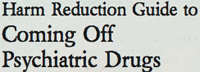
Will Hall workshop on Coming Off Medications 09HearingVoicesCongress-WillHallComingOffMedications.mp3


Creative Commons copyright
Random Impressions of the First World Hearing Voices Congress
Maastricht, 17-18 September 2009
Bill George
The Congress vividly illustrated the difficulty of balancing half truths against their counterparts. I thought the most well balanced presentation was that of Will Hall of the Icarus Project.
The conclusions I came away with from the whole were:
1. Some people who have hallucinations are not ill.
2. Both those who are ill and those who are not ill may benefit from review of their life experiences. (Caveat: I did not have the opportunity to mention that on the course Werken met Eigen Ervaring [Working with One’s Own Experience] that I attended two of the students collapsed and one resigned owing to the intensity of the emotions generated. B.G.)
3. Psychiatry sometimes does more harm than good, and at other times it is just not helpful.
The most convincing of the contributions were the recovery stories of the survivors. It is not possible to summarize them without losing their ring of authenticity. I was enthralled by the story related (in the third person) by Jacqui Dillon (UK), but would not be able to do it justice.
John Read (Australia) said the public understands that the main causes of psychoses are bad things happening, not genetics or chemicals. People who had suffered abuse are nine times more likely to suffer a psychosis; and people who had suffered from bad abuse are 48 times more likely. Service users do not agree with the psychiatric profession that questions about what happened to them in the past should not be asked.
Ron Coleman (UK) was the most dramatic and fluent speaker. Voices are not the problem – it is how you respond to them. The DSM is a comic book. “We can smell bullshit when we are offered it.” Our job as workers is to make ourselves redundant. Recovery is not an easy journey and it cannot be measured. There is no general recovery model – it is individual. Workers should dare to tell their own story.
John Watkins (Australia) said the title of his book Healing Schizophrenia was deliberately ambiguous. It was meant not only healing in the usual sense but also the healing of the concept. Some people are not distressed by the voices. They range from benign voices to pathological voices. They are not confined to people with mental health problems. Some people hear their name when falling asleep or waking up. Carl Jung referred to the tendency to split in 1937, also to sub-personalities. Usually it is not just a voice but a being attached to the voice.
Jim van Os (Netherlands) was against the bio bio bio model. Social factors play the main role. Schizophrenia as a single symptom or illness does not exist. People have various combinations of symptoms – a syndrome. The new DSM is expected to refer to dimensions
of particular types of symptoms. Don’t give up on psychiatry; but don’t expect rapid change. People and systems are conservative.
Marius Romme (Netherlands) spoke very wisely as the elder statesman about the “hearing voices experience”. But you could see his age in his manner of delivery. Psychiatrists and nurses should accept as true what people say is happening to them. Parents and doctors should give the person back the power they had taken away from them. The emotions should be allowed to connect with the voices. The voices tell about what has happened. The message they give is in order to solve a problem. The voices themselves are not psychoses. They make links to life history. It is wrong that it is forbidden to talk about the voices. The DSM should go back to emotional treatment. The therapeutic relationship with the voice hearer is important. People should be helped to cope with their emotions.
Will Hall (Icarus Project) said there was a continuum between “medication saved my life” and “medication destroyed my life”. Many people are helped by medication; others not. Coming off medication should be done gradually; although a few people have succeeded to come off cold turkey. The mistake is to think One Size Fits All. Our trust in doctors has gone down. Many don’t know the facts about medication. (I can confirm this! B.G.) People are often not informed of their options. The reason the deep down things are not talked about is because of the Blame Culture. There is a fear of taking the blame if something went wrong. In America it is the Litigation Culture.
Richard Bentall (UK) said we should make the doctors listen. They should show warmth and empathy. There is little to choose between the different schools of therapy: the Dodo Conjecture (Alice in Wonderland); every competitor wins!
The most remarkable contribution was from Brian Hartnett (Ireland). His experience is of two realities – the consensual reality and another reality in which there are voices and much more. And yet Brian is clearly not psychotic. A historical figure who had a comparable experience was Emanuel Swedenborg.
19/09/2009 20:14
I've been pondering this all afternoon (I live in Europe), but it still puzzles me. You write, you came away from the congress with the conclusion that not all people who hear voices are ill.
Further down in your comment you indirectly quote Ron Coleman (and you seem to agree), who stated the problem weren't the voices, but how people dealt with them.
Now, to me a lack of awareness toward oneself, a lack of self-consciousness, that requires the help of somebody else to be rectified, will seem little convincing as a criterion for "illness", and somehow I wonder what it is going to be: are all people ill, then, or no one?
I mean, for instance, I know how to operate a trencher. That is, I am aware of, or conscious about, how to operate one. Are you? Or would you have to ask me for help to figure it out? And, let's say you are not, and you would have to ask me for help, does that make you an ill person? Is it a disease not to know how to operate a trencher? Is it a disease not to be perfectly enlightened, entirely conscious of oneself and the world? Is it a disease not to know everything? Or is this imperfection maybe just the nature of humanity? A "disease", an "illness", all human beings suffer from. Which makes it necessary for them to communicate, be listened to, ask for help, for guidance. So that they can make sense of themselves and the world - voices, "unusual" beliefs, and the like included.
Three months ago I thought that hearing voices was a sign of disease. After the Congress I think that some people who hear voices are ill and others are not.
It is an interesting question: I will think some more about your trencher example. Bill
Now that I've listened to the rest of the talks - basically all just as great as yours/Will's and Jim van Os': When I'd heard about this congress, several months ago, I thought of going there. One of the reasons why I eventually decided not to - why I actually avoid events like this congress in general - is that to this day I get the creeps - I'm sorry, but I really mean the creeps - when I hear people talk about "a paranoid schizophrenic", for instance. And I had a hunch that I might hear someone talk about "a paranoid schizophrenic", or something along those lines. And, voilà!, here it is. Maybe my problem, but, on the other hand, how can we expect the professionals and the public to stop discriminating against us when we can't even stop discriminating against each other, referring to each other with the labels which our oppressors use to define us?
On another note: I strongly disagree that there is a role for psychiatry. There is a role for psych drugs. Without doubt. But to my conviction, there is no need for a whole medical speciality only to prescribe these drugs in those rare cases where they probably are a - temporary - solution. And there certainly is no role for what constitutes psychiatry in addition to its job of prescribing psych drugs, namely the labelling and the administration of ect.
I just listened to Jim Van Os' talk, and loved it! I'm especially fascinated, time and again, thinking of all the countless conferences - like the one he mentions - and stuff on something that doesn't really exist... Tragicomic.
Two thoughts: 1. Jim Van Os talks about a genetic predisposition - in the usual, rather simplistic, fashion. He doesn't mention that also genes themselves are influenced by the environment. That is, that a possible genetic predisposition very likely is a response to a pre-existing stressful environment.
2. The moment psychiatry really starts to be about helping people deal with psychological, spiritual, existential problems it isn't "psychiatry" (=a medical speciality) anymore. Medical science is about the body's biology. That's why psychiatry per se is biobiobio, and can never be anything else. The more psycho-social an approach to crisis, the more it involves other fields than the psychiatric one, such as philosophy, anthropology and sociology, and actually marginalizing psychiatry proportionally. You don't need to be a medical doctor to help someone with their existential problems.
(The other talk I've listened to so far is yours about coming off: great! No objections.)