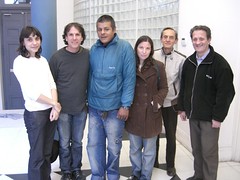
 I recently got back from a two-week trip to Buenos Aires Argentina, working with a human rights group helping people who’ve been in the psych system organize for change. Here’s a report on the trip: you can also take a look at the slideshow of my trip
Listen to my interview with Alison Hillman of MDRI
Listen to my audio interview with 3 founders of the new Argentina users group (spanish)
Listen to a great excerpt of this interview(spanish)
Listen to my interview with Laurie Ahern of MDRI on Romania and Turkey
Mental Disability Rights International MDRI website
Centro de Estudios Legales y Sociales CELS website (english and spanish)
MDRI-CELS Argentina Report (read executive summary)
Disability World web magazine interview with MDRI’s Alison Hillman
Out of the Shadows: Using Human Rights Approaches to Secure Dignity and Well-Being for People with Mental Disabilities”
 Mental Disability Rights International (MDRI) is a Washington-DC based human rights group that organizes against psychiatric abuse world wide. They’ve gotten repeated headlines and TV coverage with their campaigns, which include investigating mental institutions in Peru, Mexico, Romania, and most recently Serbia.
In September MDRI co-authored a report on the psych system in Argentina, detailing extreme mistreatment in the asylum system and calling for change. They needed a spanish-speaking survivor advocate to help their work, someone with organizing experience and group facilitation skills to collaborate with local patients, ex-patients and survivors.
 I got a call from MDRI’s Latin America program director Alison Hillman, who asked met to be part of their campaign with the Centro de Estudios Legales y Sociales (CELS). CELS is a world-reknowned Argentinian human rights group that has been a leading force in defending the victims of military dictatorship and working for democracy, and also works on mental health reform. The prospect of traveling to Buenos Aires stirred a lot of excitement in me… and also some trepidation.
Human rights work in Latin America was my earliest career path. After I graduated college I worked for the Environmental Project on Central America, a San Francisco group based at the Earth Island Institute that mobilized environmentalists against US war and military intervention in Nicaragua and El Salvador. With EPOCA I learned about non-profits and community organizing, and also got very good with my spanish. The work was extremely meaningful and important for me, a 24-7 engagement with my passion for justice, my love for the earth, and my visions of social change. It was also stressful and, at times, dangerous: a Salvadoran friend was kidnapped, tortured, and killed; a bomb went off in a university department we worked with; and our San Francisco office was under surveillance and harassed.
After two intense years, I had to leave. I was in my early twenties, and working in war zones and on the activist front lines put me in way over my young head. My long-time struggles with extreme states of consciousness meant I already had plenty of paranoia going on inside me: having to also deal with so much paranoia in the real world eventually became too much. Along with these challenges, we were also attempting, with little experience, to be both a non-profit and a democratic collective. Under those and many other pressures, I snapped, flying into a wild and irresponsible mind-storm and tearing down what I had built around me (a manic reaction to Prozac didn’t help). I ended up losing that job and career, breaking contact with all my friends and co-workers, living in poverty, and spiraling down into a very bad crisis that eventually landed me in the mental health system.
My career failure as a human rights activist did eventually lead to a new life direction as a psychiatric survivor activist. But there has always been a sense of something unfinished in the whole story, a feeling that important and vital parts of myself were left behind. Working again in Latin America, this time with a different focus but still as a human rights advocate on politicized issues, was a very meaningful opportunity. Stepping off the plane in Buenos Aires I was coming to terms with a lot of old ghosts, and to a degree returning to complete a chapter of my life.
 In some ways my 6+ years of psychiatric survivor advocacy and research in the US prepared me for the work in Argentina, but in more ways I wasn’t prepared at all. I certainly don’t believe that the US sets some kind of standard of good care in mental health, and I might even prefer to be crazy in Argentina, with its vibrant community spirit, reasonable political discource, and strong social bonds, than in the US. But being a mental patient can also mean something very different when you are in a poor country. There you might face horrifying conditions that are rarer in richer countries: starvation and dehydration, prolonged confinement, beatings, open sewers, nonexistent legal representation, and lifelong abandonment by society. In Kosovo, women are raped in psychiatric facilities in plain view of staff; in Hungary and Paraguay, patients are kept for years in cages, while in Turkey and Bulgaria, electroshock is widely used as punishment, without anesthesia or other protections.
These conditions don’t mean the US is free of extreme abuse: I know people in wealthy Northampton Massachusetts who have lived for years in government-funded group homes, technically “free” of the hospital but forced to take large doses of anti-psychotic medications that are killing them. The scars and damage they suffer in the community might in fact be a lot worse than being locked in a cage in Paraguay. You can be released from a cage: there is sometimes no way to recover from brain injury caused by medications.
 Despite Argentina being one of the richest countries in Latin America, the human rights situation for psych patients there is comparable to far poorer societies. The middle and upper classes flock to Freudian, Lacanian, and even Deleuzian psychoanalysis. The poor — who make up a huge percentage of the population now, especially after the plunder of the country by US-led financial institutions in the 90s — end up in the vast asylum system. According to the MDRI-CELS report, nearly 25,000 people are locked away in Argentina’s psychiatric institutions, where the average length of institutionalization is 9 years. Seventy-five percent of the people detained in state-run institutions are warehoused in huge facilities of 1,000 beds or more. People are routinely caught, labeled, locked away and forgotten about.
Conditions are better in the typical US animal shelter than they are in Argentina’s asylum system. There is “widespread abuse and neglect, including people burning to death in isolation cells, complete sensory deprivation in long-term isolation, forced sterilization, and sexual and physical abuse. In one psychiatric penal ward in Buenos Aires, men were locked naked in tiny, barren isolation cells with no light or ventilation for months at a time. At another institution, four people died while kept in isolation cells. Toilets overflowed with excrement and floors were flooded with urine. Investigators found a 16 year-old boy in a crib, his arms and legs tied to his body with strips of cloth, completely immobilized. Staff said he had been tied up since being admitted to the institution more than a year before.” (from the MDRI-CELS report) Patients are routinely detained arbitrarily, without legal recourse or hope of release. We were told of hospitals patrolled by armed guards, no pretension they are anything other than prisons.
The line between abuse and freedom is often drawn by class. There is even a term for it: pacientes sociales, social patients. More than 70 percent of Argentina’s psych inmates are there just because they have nowhere else to go, no family to live with, no housing they can afford.
 Campaigns have been underway for years to try to change these conditions and end the asylum system: groups including ADESAM, the Asociación por los Derechos en Salud Mental (Mental Health Rights Association), the Frente de Artistas del Borda (Hospital Borda Artists Front), and El Movimento Social de Desmanicomializacion y Transformacion Institucional (Deinstitutionalization and Institutional Transformation Social Movement) . MDRI brings global media attention, resources, and international law and human rights to help these efforts, pressuring international organizations like the Organization of American States, European Community and the UN to enforce rights protections on legal grounds.
I was constantly comparing my Argentina experience to what I’ve seen in the US. Very few US organizations for mental health reform work from a human rights legal perspective. It’s rare to emphasize, as MDRI and CELS do, no-compromise moral absolutes that are legally obligatory under international treaty. In the US, years of poltical back-and-forth have led to an Orwellian accomodation of inhuman practices to conform to the letter of rights protection law, including clever coverup techniques, cooptation of US rights activists, and the containment of most legal efforts to the under-funded, narrow agendas of the official patients rights advocacy agencies.
 For example, MDRI and CELS, follow an established human rights formula used by Americas Watch or Amnesty International: they launched an independent investigation where they actively sought out abuses, inspected facilities, interviewed survivors, publicized their findings to the world, and detailed the laws and treaties being systematically violated. Federally funded patients advocate agencies in the US lack such crusader zeal: they wait for abuses to come to them, or rely on “human rights officers” in the hospitals to file reports when these same officers are also on the hospital payroll. As a result, the vast majority of daily mistreatment in the US is covered up, ignored or considered acceptable medical practice.
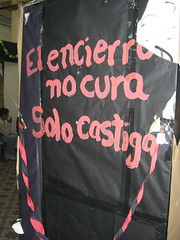 What is the G.K. Chesteton quote? The whole object of travel is not to set foot on foreign land, it is at last to set foot on one’s own country as foreign land. US hospitals and agencies have learned how to play along with the Orwellian game of psychiatric-abuse-as- usual in the US in countless ways. I am thinking for example of a woman I know who was at a hospital in, again, wealthy Northampton Massachusetts. They told her to take a medication, and she asked what her rights were to decline. So they forcibly removed her shirt in front of male staff, held her down, injected her with the drug, and then restrained her. She is a rape survivor, and this ‘treatment” was severely traumatic. Even without her special vulnerability, what they did is nothing less than assault. Unlike most survivors, she did overcome her trauma and fear and actively sought justice on her own initiative. She discovered that the Northampton hospital had not made any written records of her forced injection or restraint: it had simply left these out of her file to avoid scrutiny. Later, however, she found something even more disturbing: the very incident that had traumatized her and been omitted from her hospital clinical record, did in fact appear in the billing statement the hospital sent to the insurance company. The hospital hid the incident to avoid human rights repercussions, but then declared the same incident to get financial reimbursement. And this is just one incident that I learned about personally through Freedom Center: the tip of a much bigger iceberg of mistreatment-as-usual.
Or take a look at US efforts currently underway to “reform” what are euphemistically called “restraints and seclusion,” treatments that amount to assault, torture, and solitary confinement if you talk with most people who have been through them. The tone of state and federal initiatives is always upbeat and gradual, proud of “how far we’ve come,” as if “wouldn’t it be nice to make things a bit more comfortable for patients.” Patient legal advocates follow right along, joining the commitment to “eventually” eliminate “restraints and seclusion” in a slow process comparable to modernizing office systems. Contrast this to any of MDRI’s or CELS’s campaigns on their websites, which investigate and expose horrific conditions, analyze how they violate international law, and then call on governments to make immediate change. There is no place for “eventual” in compliance with international human rights law. Either a country is in compliance or it isn’t.
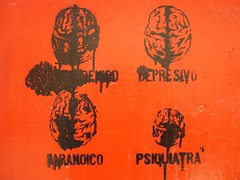 MDRI’s main partner in Argentina and co-author of the investigative report is the Centro de Estudios Legales y Sociales CELS, which aproaches psychiatric abuse from years of experience working to help victims of Argentina’s military dictatorship. CELS is part of the broader progressive human rights movement in Argentina; in the US, psychiatric human rights issues are ostracized from other progressive causes and social justice groups, even more so than disability rights in general. This is perhaps because of the unfortunate equation many progressives take in the US, advocating in a simple-minded way for more: “more social services, more medical services, more mental health services.” In an era where state social spending has been dwindling and the class politics of medical care access are grotesquely unequal, work to defend and increase budgets is vital. It’s ultimately patronizing however to think that people with no access to services are going to be happy with access to abusive and harmful services. You don’t have to be privileged to want compassionate care.
Compare all this to the CELS website:
A vast movement in defense of human rights was born and grew in Argentina between 1970 and 1980, which due to its unique characteristics, became very important at the regional and international level and continues to play a major role in the country’s political-institutional reality to this day.
The emergence of this movement responded to two concurrent circumstances: the state terrorism implemented by the military in the country since March 24, 1976 and the development of the universal human rights concept, as a result of the major political consensus after the Second World War.
The establishment of CELS in 1979, during the last military dictatorship, has to be placed in that particular context. Its creation responded to the need to develop fast and decisive actions to stop the serious and systematic human rights violations, document the state terrorism and provide legal help and assistance to the relatives of the victims, especially in the case of the detained-disappeared.
 I don’t think that Argentina is immune to the kinds of system games I find frustrating in the US, and my limited perspective and understanding of the country, combined with the very strangeness of a visit to a far away land, is no doubt distorting my view. But it was refreshing and thought-provoking to see psychiatric issues addressed from a different strategy, and I learned tremendously from the seasoned skills of Alison of MDRI, who has years of experience as a human rights advocate and shares my own roots in work in Central America. I also learned a lot from our other main collaborator, the formidable Roxana Amendolaro of CELS, a psychologist and legal advocate with great talents and dedication building bridges and collaboration between different social and professional sectors. Roxana impressed me by embodying in one high-energy mind a human rights advocate, a practicing psychologist, and a political philosopher comfortable discussing Jacques Lacan and Felix Guattari. Spending time with her was a small taste of Argentina’s sophisticated intellectual atmosphere, where ambitious ideas and theories have a vitality directly touching daily life.
My third guide to the different terrain of Argentina rights work was Agustina Vidal, who discovered the Icarus Project accidentally through her interest in the Drupal software platform we transferred the Icarus website onto. Agustina was a gracious host, sharing her (husband and 3 bunnies-filled) apartment with me during part of my trip. When I introduced her to Alison and Roxana, she became a key organizer with getting the patients’ movement efforts off the ground.
Agustina, Alison and Roxana were mercifully forgiving towards my stumbling castellano (spanish). Though I took a summer trip this year to Chiapas, the rust was still pretty thick on my language skills: I forgot to use vos instead of tu, confused my masculines and feminines (though I realize this is generally a positive trait in other contexts), dropped into brief dissociative fugues searching my painfully small vocabulary, and mangled verb tenses. Over and over again. Trying to phrase something just right about states of madness or organizing strategy is hard enough in english: one-on-one in castellano it was a huge stretch, and the times I facilitated large groups were some of the most daunting I’ve ever faced. I’m still glad people were too polite to correct me on the egregious errors I no doubt must have made in front of a crowd.
 I tagged along for a number of meetings with policy makers and legal advocates, slowly getting a small understanding of some of the politics of Argentina’s frightening asylum system. Mostly I listened and absorbed (or sat puzzled, paging through a dictionary), and occasionally offered Alison, Agustina, Roxana, and the people we met my thoughts on how things compare to the US. Like the US medical system in general, mental health policy in Argentina is deeply fragmented, with multiple agencies and offices holding parts of the institutional responsibility for the lives of individuals. Fragmentation suits the system’s bureaucrats, because as a result it is harder to pin the blame on anyone in particular for abuses taking place, and harder to address systemic and general problems. No agency or office wants to step out of this lack of accountability and take leadership on system reform: they fear that as a reform leader they’ll also be accountable for reform failures. It’s a political hot potato. (Anyone help me translate ‘hot potato’ into castellano?) Meeting after meeting heard agreement that the human rights situation is unacceptable and in violation of international law, and meeting after meeting left us with the message that someone else needs to change things. Meanwhile the asylums are full.
 The hospital system takes up the vast majority of the mental health budget, so theoretically getting people out of the asylums and into the community would mean the somewhat easier task of shifting money already being spent, rather than spending more money. Where would those cuts in the hospital system take place? Who loses their jobs, who loses their positions — and how does this get decided when no one is taking leadership for reform? There is a signature campaign for a national mental health reform policy, and it’s clear that some kind of federal action and country-wide plan are needed to get people out of the hospitals (living in the community is a basic human right). Argentina has some progressive mental health laws on the books, but, like the US, enforcement needs political willpower that is lacking in a system where the money keeps flowing to the status quo and the political cost of changing is higher than the political cost of stalling. The relative powerlessness of patients to advocate for themselves or pressure for change — a direct result of their poverty and oppression — keeps the whole arrangement in place.
On the other side of this equation, it is inspiring to think about what broad-based community mental health care might look like in Argentina. Rather than the crude myths of biological determinism and salvation-through-medication that hold sway in the US, Argentina has a strong culture of understanding the mind psychologically, in socal context, and even politically. I met people who combined psychology with political analysis of capitalism and domination, and linked the oppression of mental patients with larger issues of participatory democracy and community empowerment. Argentina has historical ties with Italy, and there is a valuable collaboration with Italian progressive mental health reformers, who have pushed very innovative community care systems in Italy and worked for a complete end to psychiatric institions. With one of the per-capita highest populations of psychotherapists in the world, most of whom are more interested in analyzing dreams than in prescribng medications, Argentina has an opportunity for a thoughtful dialog on how to best help people going through extreme emotional distress.
 A lot of questions remain from the US experience, however. Argentina’s deinstitutionalization process, if and when they start moving people out of the asylums, will potentially face the same problems as deinstitutionalization in the US. Will money for community services really be available? Or will the criminal justice system and emergency care fill in the gaps? Will community mental health services be designed and implemented by professionals with the asylum mentality, creating a ‘hospital without walls’ as in the US? Will pills be pushed in the community and pharmaceutical advertising dominate understandings of mental health? Will mental health be separated from larger issues of social justice, poverty, and democracy? Will professionals continue to see themselves as experts, or will they see themselves as collaborators, needing to be trained by people who’ve been through madness and lived in institutions? Will the country embrace the propaganda that “mental illness is a disease like any other,” or will they heed the research showing the disease definition only furthers stigma and segregation? Will a trauma approach come to the fore, or be marginalized? Will the ranks of mental health bureaucrats continue to swell? Will the idea of empowerment and representation by ex-patients be turned into hiring tokens for committees that go along with business as usual? Will professionals and advocates understand the importance of patients/users having their own voice and leading their own reforms? And what about the private institutions that MDRI and CELS have not had an opportunity to investigate?
There were some exciting steps in the right direction. Roxana and the CELS staff are starting plans to set up a legal aid clinic through a local university, making arrangements to use law student as free legal advisors. Argentina doesn’t have the structure in the US, limited as it is, of legal assistance to psychiatric patients, and many people could be freed from the aslyums if they just had a little help making it through the courts. Another idea was to devote a small staff to periodic observer visits to hospitals. Such observers might only be able to show up infrequently, but their unexpected presence could have a very powerful chilling effect on staff, who would have to think twice about getting caught before harming patients.
 I was also inspired by the people I met at a talk i gave for the University of Buenos Aires social sciences department (yes, the same university Slavoj Zizek spoke at in the film Zizek!). I was invited to be on a panel for a post-graduate class on “collective health,” an interdisciplinary approach that reflects social and political understandings rare in the US. The classroom brought together psychologists, doctors, social workers and counselors: virtually everyone was some flavor of leftist and or feminist. Also on the panel were Roxana talking about the MDRI-CELS report, a doctor talking about orphans and foster care, and a psychologist discussing harm reduction policies towards drug addiction. In completely unfamiliar territory, I had no idea what bullseye I was trying to hit with my own talk. Was it stereotype-busting, the “Hey look, someone with a schizophrenia diagnosis who is (relatively) well groomed and nonviolent!” message? Was it to tell horror stories of psych abuse? Bash Big Pharma? Infomercial for the international survivor movement? Present my analysis of capitalism and mental health? Disavow Bush’s imperialist policies in South America? Somehow I made it through, and since I got the only applause of any of the presentations, I think I hit somewhere on the target (whether I pronounced desmanicomializacion correctly is another question).
The other panelists gave the kinds of talks that ask hard questions and address real substance. I was then pleasantly taken off guard when the audience started speaking up and taking things to a whole new level. Weren’t there real dangers of coercive control accompanying medicalization of drug addiction, even if this were better than current criminalization? Why were we allowing social service agendas to separate issues ultimately defined by who controls economic resources? What value are policies set outside movements led by the people affected? Things got heated quickly, but it felt like real intelligent engagement. These were people, it seemed from my foreigner’s perspective, discussing ideas that really mattered to them. The tone was energized and dynamic in the way that makes people in the US uncomfortable, and I was reminded of how in the US we are often so isolated and coddled by mass media that we feel injured by open disagreement, and can only handle group conformity or politeness. Of course, everyone in the room (other than me) had experienced the dramatic economic destruction wrought on Argentina by the world financial system: ideas and discussions become real very quickly when you know that your own livelihood is at stake.
Later Roxana and I talk about themes I first became interested in when I organized a Paolo Freire-Antonio Gramsci study group in San Francisco in 1990: fostering cultures and communities of liberation on a small scale. I make a shopping list of books in castellano by post-structuralist left wing psychologists: Pichon Riviere, Ana Fernandez, and Suely Rolnik. They might be hard for me to understand in castellano, but then again, post-structuralism is hard to understand in english. Coming back to the US, my own intellectual political theory side has been re-envigorated, and I feel inspired to tackle some of the Big Questions of political philosophy and theory that get set aside by too much single-issue, pragmatic politics.
 On our visit to the enormous El Borda Neurospsychiatric Institute in Buenos Aires, which covers several city blocks, Agustina tells me, only half-jokingly, she’s scared we might not make it back. El Borda has that quality: a monstruous abyss, whose depth no one could ever measure. And it is, apparently, among the more humane of the asylums. I ask one of our guides, the progessive Dr. Alberto Sava, how many inmates (internados) the hospital holds. “No one knows,” he says. There are estimates of a thousand, eleven hundred, but no records keep accurate count. People truly are lost here. The grounds are eerily empty, and the colorful murals we find, silent on the outer walls of huge multi-storied buildings, are like cryptic messages left by ghosts. The amazing Argentine film Man Facing Southeast was filmed at El Borda. “El Borda is like a paradise compared to the other hospitals,’ Dr. Sava says. “They are like concentration camps.” He tells us about the separate women’s asylum nearby and its authoritarian, dictatorship-era director. We pass the prison hospital, where the police put suspects deemed crazy and where the MDRI-CELS investigation found people were being held in solitary confinement, naked in the dark, for months. A first priority, Dr. Sava says, is closing the prison hospital entirely.
 Dr. Sava is the founder and director of the Frente de Artistas del Borda, and we visit the arts group they are running. The group has a dusty converted shed to meet in and very little in the way of supplies, but the other hospitals have no arts of any kind, and the group, with more than 100 patients involved, has made a real impact on the atmosphere of the institution. IInmates get to show they are ready and capable of living independently, and hopefully hasten their release, and the group also organizes a Latin America wide patients arts festival. We check out some wild and soulful paintings (you can see many of them in this post and my slideshow), meet a documentary film crew also visiting, and stop by the building used by Radio Colifata, the internationally-reknowned radio station that features patients from El Borda. Radio Colifata is primarily entertainment, not advocacy or politics, but several of the participants in the patients/users group that I meet and hang out with are also involved with Colifata.
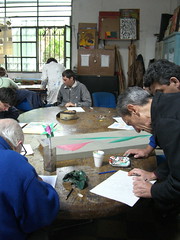 During our hospital tour I’m once again impressed by Carlos Moretti, one of the patient/user organizers and a workshop leader of the Frente de Artistas. As I watch him at the arts workshop and meet some of the other inmates, he seems to have strong connections and a clear sense of mutual support as well as advocacy for change; in the users/patients group meetings he is an outstanding leader, one who knows when to step forward and also when to let others in the group learn to find their own voices.
My most important responsibility during the Argentina visit is helping plan the big deinstitutionalization meeting MDRI and CELS have organized, titled “La reforma del sistema de salud mental en Argentina: pasos y articulaciones necesarias para elaborar una agenda conjunta.” More than 60 people involved with mental health in some capacity crowd into the conference room at CELS: lawyers, psychologists, legislators, academics, social workers, community activists, and patient/users/ex-patients. My language limitations become an asset in social observations: I tune in to the nonverbal cues and body language at this gathering of mostly professionals. Sadly, the patients/users present, who I consider the most important participants, are experiencing subtle ostracism and exclusion by the professionals, rather than being welcomed and honored. Seeing this happen here, where we are all gathering under the shared goal of defending human rights, reminds me how much there is to do in this country, both on a grand scale and on the interpersonal level of attitudes and interactions.
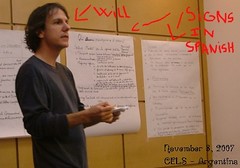 Though fractured by these rank and status divisions, the big meeting is unlike anything I’ve ever seen in the US. Here again, broader social issues are more closely tied to the “mental health” topic, which tends to be discussed more in a vacuum in the US. It’s hard to imagine any mental health reform gathering in the US — whether within the system or among independent advocates — discussing guaranteed income for all, decriminalizing the war on drugs, access to abortion, or challenging the politics and ideology of “dangerousness.” When people name these big issues — true as they might be — the response is usually that you aren’t being realistic, that you are just dreaming for pie in the sky, and let’s get back to our work of attending to the small and narrow. I’m so used to my voice being on the left and the fringe, it’s dizzying to be in a society where progressive ideas and ambitions for real social change are much more widely accepted.
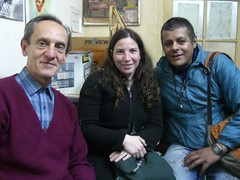 In our planning we sweated over the details of how to best create a working environment for 60+ people, finally settling on small groups by professional affiliation, which allowed familiar discussions to go deeper and common experiences to move towards concrete action. Allison. Agustina, and Roxana are watching my back, but I’m filled with fear at the challenge of co-facilitating all these people — some with a lot of social status — in castellano. What if my pronunciation or grammar or vocabulary have me saying something i don’t mean? Or what if I go into one of my altered states of consciousness? How do you translate “Excuse me, but a giant demonic spider is eating my aetheric body right now, can we take a break?” After it’s all over we de-brief, and it turns out the meeting was a huge success, with overwhelming positive feedback and enthusiasm, and growing energy and momentum. Later some things start moving in the media, and, most importantly, Argentina’s first independent organization of users/patients/ex-patients is starting to take form.
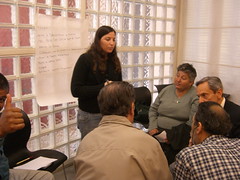 A high point of the meeting was watching Agustina and Carlos give the presentation from their working group. Agustina says she has never given a public speech before, but I don’t believe her: she nearly burned down the room with a rousing and passionate appeal for self-determination, independence of the asylum mentality, alternatives to labels and medications, and community controlled responses to emotional crisis. Most of the professionals in the room had never heard mental patients and people labeled with disorders speaking on their own behalf before, clearly and articulately demanding an end to the system.The applause she and Carlos get at the end was thunderous and longer than any other moment in the meeting. (Even if you don’t speak spanish, listen to this short audio of Agustina reading the users’s group invitation, and you’ll get a small taste of her superpowers.)
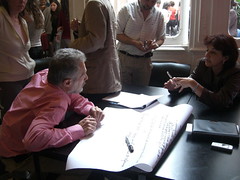 The meeting of users/patients/ex-patients covers themes common to groups in the US: The need for income, especially jobs that offer flexibility and accommodation, and not paternalistic jobs with lower pay and status. Lack of effective legal representation. Rampant abuses in the hospitals with no oversight or prosecution of perpetrators. Places to go in the community. Real alternatives to the hospitals. Police harassment. We hear stories of arbitrary confinement, poverty, and of course the awful experiences many people have being medication. Some participants are bloated and toxic, with stiff bodies, blank looks, and drowsy minds. Like gatherings in the US, here too there are people surprised to learn for the first time that many people can live without medications. No one ever told them this might be possible.
There is discussion of what to call ourselves. Survivors? I ask. “We don’t want to be called survivors. Argentinians are already survivors of too many things.” So the group, like so many groups around the world in a system where control of language is part of the problem, tries to figure out what to call itself. Finally everyone settles on “usuarios” — users. I am reminded of the progressive step from “patients” to “consumers” in the US — but also how limiting this term can eventually become, and I wonder how things will evolve in Argentina. After some discussion we also enthusiastically agree to continue to invite our colleague Roxana of CELS, who does not carry a psych diagnosis or hospitalization history, to participate. She’s proven her flexibility, sensitivity, and value as an ally, and the point is to make change, not exclude people.
Agustina recounts some of the stories we heard at the users meetings:
S was a woman in her 40s with fragile nerves when after a lovers fight, her partner committed her to a public mental hospital saying he was afraid she would hurt herself. He agreed to pick her up in 48 hours. Three days had passed and no signs of the man, 4 days, a week and S was still waiting at the hospital for her partner to come for her. A gentle soul heard her story and went to S’s house to see what was going on. The partner had taken off and S was left in hospital with nothing else but what she was wearing. Poor and homeless, no judge will let her out to live in the streets. 8 years later, she is still in hospital struggling to be released.
N had an abusive father, who when she was 17 married an equally abusive woman. N was literally the slave of the house. When she was 20 one day she couldn’t take it any more, grabbed her belongings, the little savings she had and left home. Somehow she got involved with parapsychology, and she was told she had bad aura or karma or something and she would always be abused until she was healed. She was scammed and lost everything. She went after them and asked a hearing with a judge. She was a nervous mess, and the judge heard her story and decided she needed to spend some time in the hospital to calm down. She was committed, she lost her job, her house and everything she had. N never was medicated and the doctors discontinued treatment a week later, but the judge did not discharge her since she was now homeless. It’s being 5 years and she is still inside the mental hospital.
When you are poor and have nobody to go to for help, there is no way to know when forced treatment will end. The moment that forced treatment was applied, against your will you lost your condition, from person to patient, in one minute, and you can’t get it back when you decide you are ready to.
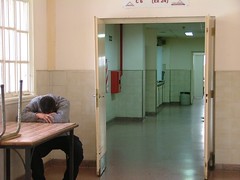 (photo by Agustina Vidal) And it doesn’t only happen if you are poor, another person from our group J, has been living with a diagnosis of schizophrenia for the past 20 years. His mother, along with other parents, founded an organization very similar to NAMI, very medical model, very pro-pharmaceuticals. J’s family went to court and declared him incompetent. His family now is in charge of making every decision regarding to his life, from what treatment he follows to what girl he can date to where he can drive his car. J is very aware of what’s going own, he is very loud and vocal regarding what he wants, but nobody can hear him, and to the law, his voice doesn’t count anymore. He wants to stop taking at least some of the many pills he takes cause he feels numb, but it’s not up to him, it’s up to his family.
One member summarizes the experience of everyone: “We have been totally abandoned by the government… We are not garbage, we are not useless people. We are human beings.”
Visiting Buenos Aires
 Argentina has always fascinated me, since I read Manuel Puig and Julio Cortazar novels and first learned about the country’s complicated and tragic political history. I managed to combine my CELS-MDRI work with some yes-I’m-a-tourist wandering around, just scratching the surface of this incredible city. It was not nearly enough.
The common political discourse is decidedly to the left, a relief from the narrowness and media-induced stupidity of much US political thinking (you might begin by asking whether the US is really a democracy, then see if you can find a discussion of this fundamental issue somewhere on TV). Photos of Che were commonplace, and the country’s strong women’s movement was evident in pro-abortion and contraceptiion rights graffiti and the recent election of Christina Kirchner as president. Political magazines and books filled the shops and stalls everywhere, along with huge amounts of psychoanalysis and psychology texts. It was great getting into a long conversation with friends about Hugo Chavez. Chavez had just had his fight with the King of Spain, and I enjoyed hearing an anti-authoritarian critique of Chavez that wasn’t confined to the terms of CNN but looked at the question of what it would really take to promote a popular democracy in a US-dominated work economic empire.
I discovered cool t-shirt stalls and watched tango on the streets, bought a selection of documentary films about Argentina history, went to a smokey and crowded queer dance club, chilled out in Agustina’s apartment with a dubbed Peter Falk film, saw a political play, explored the catacombs of Avenida Corrientes bookstores, bought mate gourds, watched tango, listened to punk rock in castellano, mingled with fans at the Bjork concert, and in general tried to drink the very big lake that is Buenos Aires through the very small straw that was my short visit.
There is a lot less poverty and homelessness on the streets of Buenos Aires than New York or San Francisco, and I am astonished to learn that the subway system doesn’t have any rats. Racism, however, strikes me as more extreme in Argentina than the US. Whites completely dominate public life and the media; mixed race mestizos haunt the margins, seen working the more menial jobs like street vending and the occasional street beggar. Indigenous people have been virtually wiped out in Argentina, with no visibility I could see. The media make whiteness the standard of normalcy to a much greater degree than the US, and multiculturalism, not a great solution in any case, doesn’t seem to have taken hold here at all.
The recent dictatorship is ever present, a common backdrop to everyone’s awareness, but also talked about only awkwardly, with an unmistakeable tension, a slight flinching in the body and face. Trauma, survivor guilt, fear of the future, personal choices made, secrets, codes, and keywords. I can only imagine what it must be like to be an Argentinian and live with this reality, and my sense of things is put together only from brief glimpses in conversations and the reading I’ve done. The film Historia Oficial helped me understand a little, but don’t comfort yourself with the thought that Argentina’s violent political history is just the exotic story of a far away country. The Dirty War, where so many people were killed (“disappeared”), is also very much part of US history.
I first studied Argentina’s politics in a class at Yale in 1982, when I saw a Costa-Gavras film about Uruguay and had a reading assignment about the coup against Allende in Chile. South America, I learned, has been a target of extensive US covert operations and intervention, with Argentina target of a region-wide strategy of political control aimed to protect corporate interests from any threat, including the threat of democratic government. Google for example Operation Condor, Argentinian generals trained at the US School of the Americas, or read about US Secretary of State Henry Kissinger’s role in Argentina’s military coup. Information that’s known and easily available is already damning enough, but we may never uncover the full story of US involvement in South American dictatorship. (Read for example, “Kissinger Approved Argentinian Dirty War” in the UK Guardian, or this article from the Miami Herald.)
Today US influence on Argentina’s politics continues in more sophisticated ways, through the power of international finance, banking, and globalization. The country recently suffered a dramatic US-backed economic crash that hit the middle class very hard and radicalized the entire population. Hundreds of thousands took to the streets demanding their bank accounts be restored and calling for jobs and social programs. Those protests died down with a change in economic direction, but Argentina is still on edge and the economic comeback is very tenuous. Poverty and inequality remain much bigger than they’ve ever been historically, a clear sign that business as usual in the Washington-led free market globalization strategy is not sustainable or desirable. Now that left governments are on the rise in Latin America, the future might presents great opportunities. Argentina is taking debate over the country’s overall direction seriously, with discussions going on about the vision for the entire society. It’s a far cry from the complacency of the US, where most progressives can’t see past the dead-end debate between which candidate has stronger media appeal.
With its passionate politics, vibrant culture, and emerging mental health users’s movement, Argentina awakened in me greater hope. This very much alive country has a strong spirit for change, and it’s an honor to be playing a small part in the beginnings of independent psych patient organizing. My visit helped make peace with some personal ghosts, bring one chapter of my life to a close ,and start another. Despite a disastrous mental health system, activists are leading the way for something different. Today looking back on this amazing trip, I’m missing my friends and longing to return to Argentina, thinking of ways I can study castellano and be part of more mental health organizing. Much lIke my own life, Argentina has come through trauma and still struggles with past scars and fears for what might happen next. The country, however, isn’t afraid to begin to write its own future, and we all could use some of that courage.

 Hi everyone, happy World Hearing Voices Day. I’m terribly jet lagged but just arrived in Valkenburg Holland for the World Hearing Voices Congress. (also check out the audio)


 A listener emailed this:
 I’m glad you asked, I was just thinking that.
 Madness Radio is a labor of love but it is a labor. Thanksgiving and the holidays, filled with family memories and ‘issues,’ are a good time to get my mind off people and focus on technology, and the results are a new website for Madness Radio — long overdue.
 I was really excited to get this email from a listener in Prague Czech Republic! Here’s the email she sent — and also check out her powerful poem…
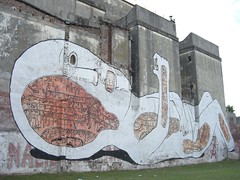 Photos from my recent trip to Buenos Aires Argentina to work with Mental Disability Rights International and the Centro de Estudios Legales y Sociales in the effort to reform the country’s abusive asylum system.
 Icarus collective member Will Hall was invited to speak at a 150 year-old psychiatric hospital in Toronto Canada with a group of family members about how to help their relatives going through mental health crisis, sponsored by the innovative Family Outreach and Response agency.
 Families are ground zero in mental health. When someone goes into crisis, withdraws from reality or starts to experience too much of reality, the family is often there right along with them. Parents and siblings are either directly involved, such as caregivers or a source of shelter, or they’re circulating around as memories and voices in the person’s head. Under the stress of someone driven mad, or under the same stresses that drove the person mad to begin with, families are usually in some kind of crisis themselves, though they may be ‘functioning’ and passing for normal more than the person who is diagnosed. Over the seen years I’ve been a peer counselor and human rights advocate in mental health, some of the most challenging and rewarding moments have been meeting and working with the family members of people in the system.
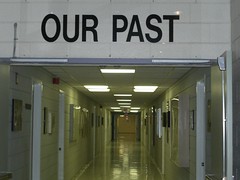 — That’s inside CAMH — they are planning on tearing it down, and rebuilding it.
















 Creative Commons 2.5 copyright
Recent Comments